
A history of fluoride
By: Jeffery W. Johnston, DDS, MS, Chief Science Officer, Delta Dental of Michigan
As a practicing dentist for many years, I've discussed fluoride extensively. But I'm not sure I've ever talked about it as much as I have over the past year or so.
Fluoridation is an issue I will continue to discuss because, as protectors of oral health, we must. It's too important not to.
In 1530, German mineralogist Georgius Agricola described a crystalline material that facilitated the melting of ores at lower temperatures. He called it "fluores," from the Latin "fluere," meaning "to flow." Today, it is known as fluorspar, fluorite or calcium fluoride.
Karl W. Scheele identified fluorine in 1771. French scientist Andre Ampere coined the name fluorine in 1812. Henri Moissan, a French chemist, is credited as the first to isolate
fluorine in 1886 by electrolyzing potassium bifluoride dissolved in liquid hydrofluoric acid.
In 1900, Dr. Frederick S. McKay graduated from the University of Pennsylvania School of Dentistry. In 1901, as a suspected tuberculosis patient, he moved to Colorado Springs, Colorado, to set up a dental practice in the dry air. He soon noticed his patients had a mysterious brown stain on their teeth. This was also studied by Dr. J.M. Eager, an American dentist stationed in Naples, Italy, in 1902. These teeth were unusually resistant to caries. McKay coined the phrase "Colorado Brown Stain" to describe the condition.
The Colorado Springs Dental Society conducted a study showing that nearly 90% of the city's locally born children had signs of brown stains. City residents on city water did not have the stains. To investigate further, McKay contacted G.V. Black, a renowned expert at Northwestern University. They studied the cause of the stain until Black's death in 1915.
In the United Kingdom, Dr. Norman Ainsworth found dental staining similar to McKay's description of "Rocky Mountain Mottled Teeth." Ainsworth examined more than 4,000 children and produced a statistical comparison of decay rates between populations with and without the staining. His study showed that those with mottled teeth tended to have fewer caries.
In 1923, reports from Oakley, Idaho, noted that brown stains appeared shortly after the town constructed a communal water pipeline to a warm spring five miles away. Suspecting something in the water, McKay advised parents to change water sources. Within a few years, the brown stains disappeared.
The cause remained elusive until McKay read a paper from Bauxite, Arkansas, where the Aluminum Company of America (ALCOA) used bauxite ore in aluminum production. ALCOA's chief chemist, Dr. H.V. Churchill, using photo-spectrographic analysis, discovered that the water had a high concentration of fluoride. In 1931, Churchill wrote to McKay outlining his findings. It appeared the 30-year mystery had been solved.
Dr. H. Trendley Dean at the National Institutes of Health, along with senior chemist Dr. Elias Elvove, determined that the risk of brown staining began when fluoride levels exceeded 1.0 parts per million. Dean then investigated whether the low incidence of caries, as reported by Black and McKay in Dental Cosmos (1916), was attributed to fluoride in the water. He hypothesized that adding fluoride to drinking water at safe levels would reduce dental caries. To test this, he needed a large-scale study.
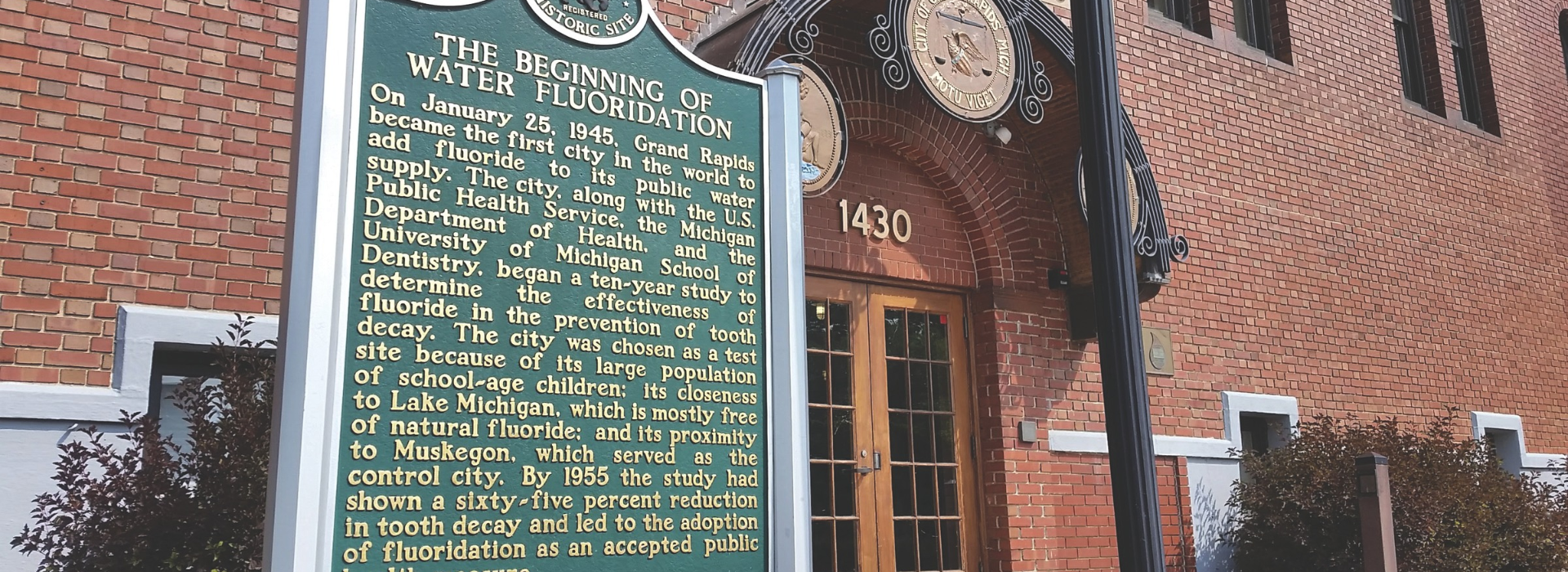
In 1945, Grand Rapids, Michigan, became the first city in the world to fluoridate its drinking water.
A significant moment in oral health history
On Jan. 25, 1945, the Michigan city of Grand Rapids quietly entered the history books. That winter day marked the beginning of one of the most significant public health experiments of the 20th century: the first large-scale community water fluoridation program in the world. What began as a local initiative would soon become a national model—reshaping the way governments approach dental health and laying the groundwork for widespread prevention of tooth decay in the United States and beyond.
But why Grand Rapids? What made this mid-sized city in western Michigan the right place to launch such an unprecedented scientific and public health effort? The answer lies in a combination of science, infrastructure, demographics, and collaboration between federal and local officials.
In the early 20th century, dental caries was one of the most prevalent chronic diseases in the United States. Nearly every child and adult was affected.1 Dentists and researchers across the country were desperate to find ways to reduce the burden of decay, particularly in children.
It wasn’t until the 1930s that public health officials began to connect fluoride—a naturally occurring mineral in water—with stronger teeth and lower rates of decay. Dr. H. Trendley Dean, a dental officer in the U.S. Public Health Service (USPHS), had been investigating communities where drinking water contained naturally high levels of fluoride. He discovered a clear trend: people in these areas had fewer cavities. In some places, however, high fluoride levels also caused fluorosis, a cosmetic mottling of the teeth.
Dean and other scientists concluded that there was a "sweet spot"—a concentration of fluoride that would significantly reduce decay while avoiding fluorosis. This led to the idea of adding fluoride to municipal water supplies to achieve that optimal level and test its effect on an entire population.
By the early 1940s, the USPHS was ready to move from observation to experimentation. Officials began searching for a city that would serve as a controlled site for the first deliberate fluoridation of a public water system. Several criteria were considered: the city needed a stable population, reliable health and dental records, capable infrastructure, and a cooperative local government.
Grand Rapids stood out on all counts. With a population of about 140,000 at the time, it was large enough to provide meaningful data but small enough to manage effectively. The city had a strong public health department, local officials who were open to scientific innovation, and a central water system that made fluoridation logistically feasible.
In The Fluoride Wars: How a Modest Public Health Measure Became America’s Longest-Running Political Melodrama by R. Allan Freeze and Jay H. Lehr, lead program researcher Dean stated:
“In Grand Rapids we found a community with excellent health department facilities, enthusiastic cooperation, and a population large enough to make the experiment significant.”
Just as important was the presence of nearby comparison city Muskegon, located about 40 miles away. Muskegon was demographically similar to Grand Rapids but would not fluoridate its water for the first five years. This allowed scientists to use Muskegon as a control group in the study—one of the first large-scale examples of a population-level public health experiment using comparative analysis.
On Jan. 25, 1945, Grand Rapids officially began adding fluoride to its municipal water supply. The concentration was carefully calculated to reach approximately 1.0 part per million (ppm), a level that research had shown would reduce tooth decay without causing noticeable fluorosis in most people.
Over the following years, a team of dentists, public health officials and scientists conducted rigorous studies on school-aged children in both Grand Rapids and Muskegon. The results were striking. Within five years, children in Grand Rapids were experiencing a 60% reduction in tooth decay compared to their counterparts in Muskegon.2
Although the original plan called for a 15-year study comparing Grand Rapids and Muskegon, the experiment was effectively cut short when Muskegon began fluoridating its own water supply in 1951—just six years into the trial. Why the abbreviated timeline? The results in Grand Rapids had been so compelling that continuing to withhold fluoride from Muskegon was seen as ethically questionable. While this shortened the formal study period, researchers had already gathered substantial evidence confirming the benefits of fluoridation. The early termination of the control group phase did not diminish the study’s scientific credibility; instead, it underscored the overwhelming success of the program and helped accelerate the nationwide adoption of water fluoridation.
“Grand Rapids became a model for the world,” wrote public health scholar Catherine Carstairs in her book, The Smile Gap: A History of Oral Health and Social Inequality.
“Its success helped convince countless communities that fluoridation was not only safe but profoundly effective.”
The success of the Grand Rapids experiment helped launch a wave of community water fluoridation programs across the United States and later in other countries. By 1960, thousands of cities had followed suit. Today, more than 200 million Americans have access to fluoridated water—a testament to the enduring impact of that initial effort in western Michigan.
The Centers for Disease Control and Prevention (CDC) later named community water fluoridation one of the 10 greatest public health achievements of the 20th century, alongside vaccines, tobacco control and safer workplaces.
Of course, not everyone embraced fluoridation. From its earliest days, the practice attracted criticism from skeptics and conspiracy theorists. Some questioned the ethics of adding chemicals to public water supplies, while others raised concerns about long-term health risks—a debate that has seen newfound attention in recent years.
The overwhelming body of scientific evidence has consistently supported the safety and effectiveness of water fluoridation. Multiple studies have confirmed its ability to reduce cavities by 25% to 30% across populations, regardless of age or income.3
Nearly 80 years later, Grand Rapids still stands as a symbol of public health innovation. The city's decision to partner with federal researchers and take a bold step toward disease prevention changed the course of dental health for generations.
While the fluoridation experiment began as a local endeavor, its success echoed globally. It demonstrated that large-scale, community-based prevention was not only possible, but transformative.
As cities and nations continue to grapple with rising health care costs and health disparities, the lesson of Grand Rapids remains clear: prevention works. And sometimes, it starts with something as simple—and powerful—as a glass of water.
Related Articles
Find a dental plan that is right for you
Find a Dental Plan